Dev Q&A #2 | Development Process & The Future
Hell Let Loose: Vietnam Developer Q&A: Development Process & The Future
Welcome to the Command Post.
In Part 1 of our Hell Let Loose: Vietnam Developer Q&A, the team answered your questions about performance, gameplay and maps.
For Part 2, we're going behind the scenes to explore how the team has developed a new Hell Let Loose experience, the ideas that were tested along the way, and how the Vietnam and World War II development teams work together, and also a look toward the future of the game, talking about the team’s long-term ambitions for Hell Let Loose: Vietnam.
A huge thank you once again to everyone who submitted questions across Reddit, Discord and on socials.
Full Summary of the Developer Q&A: Part 2
Video Running Order:
Looking for a specific question? Use the timestamps below to jump to each section of the video.
Behind the Development
- 00:00 - What were the challenges of making a new HLL game?
- 02:25 - How has the role of teamwork changed?
- 03:46 - Which features were cut during development?
- 08:00 - Misconceptions about HLL:V the team would like to touch on?
- 09:58 - How do the Vietnam and WW2 teams work together?
- 12:50 - Memorable moments from development
- 13:46 - What are the team most excited for players to experience?
- 18:27 - Topic: Looking to the Future
Looking to the Future
- 18:27 - Future factions and uniforms
- 20:04 - New helicopters and vehicles
- 22:02 - Weather and environmental changes
- 28:10 - Battalions and community support
- 30:04 - Era-appropriate licensed music
- 31:26 - How will we support streamers & content creators?
- 32:02 - The live-service roadmap
- 33:00 - Long-term development goals
- 36:28 - What are the developers most excited about ahead of launch?
For those who prefer to read rather than watch, we have summarised the full discussion below, breaking down each question and the key points shared by the team.
From the challenges of developing a new Hell Let Loose experience to future content, this Q&A provides a closer look at both the journey towards launch and the team's long-term vision for the game.
Featured in this Developer Q&A from Expression Games are:
- Paul Rustchynsky - Game Director
- Sam Warren - Development Director
- Ryan Playle-Howard - Senior Art Director
- Kieran D'Archambaud - Studio Technical Director
We hope you enjoy the read, and as always, we'd love to hear your thoughts in the comments.
Topic: Behind the Development
Developing Hell Let Loose: Vietnam has meant finding the right balance between familiarity and innovation. The team’s ultimate goal was to preserve the foundations that define Hell Let Loose, including 50v50 battles, the command structure and the importance of communication, while introducing new mechanics and tactical opportunities inspired by the Vietnam War.
This approach has shaped every part of development, from the asymmetrical design of the US Forces and NVA to the introduction of helicopters, tunnels and more dynamic battlefields.
How was the Hell Let Loose formula adapted for Vietnam?
One of the greatest challenges when expanding an established franchise is introducing meaningful changes without losing what players already love. For Hell Let Loose: Vietnam, the team began by identifying the core principles that needed to remain unchanged. The game continues to centre around large-scale 50v50 battles, a structured chain of command and teamwork between Commanders, Officers and individual squads.
From there, the focus shifted towards the Vietnam War and the unique equipment, environments and tactics used by its opposing forces. Rather than creating two mirrored factions, the US Forces and NVA have been designed around different strengths and capabilities. Helicopters, tunnels, faction-specific logistics and distinct weapons all create new tactical opportunities while remaining grounded in the wider Hell Let Loose formula.
The goal is to provide an experience that feels immediately recognisable to existing players while offering a genuinely different battlefield for both returning veterans and those discovering the franchise for the first time.
Which mechanics have changed the most?
Tunnels and helicopters represent the biggest changes to the traditional Hell Let Loose experience.
The NVA tunnel network introduces a new layer of strategy, allowing teams to establish routes across the battlefield and move soldiers between key positions. This changes both short-term tactical decisions and the wider strategy of an entire match, as tunnel placement and protection become central to the NVA's ability to maintain pressure.
Helicopters on the other hand provide the US Forces with an equally significant mobility advantage. Their ability to rapidly transport troops and supplies means squads can respond to threats, reinforce objectives or establish positions behind enemy lines much faster than before.
These systems are supported by smaller differences across weapons, vehicles and faction loadouts. Together, they create an asymmetrical battlefield where each side must understand and make effective use of its own capabilities.
Has the role of teamwork changed?
Teamwork remains at the heart of Hell Let Loose: Vietnam, but the amount of information teams must communicate has increased. Traditional Warfare and Offensive matches continue to feature recognisable frontlines, but the arrival of helicopters and tunnels means those frontlines can change much more quickly. A helicopter can transport a squad across the battlefield in seconds, whilst tunnels can allow NVA forces to emerge from unexpected positions.
The game will also introduce new game modes with more dynamic objectives, requiring teams to move across the map and respond to changing threats rather than concentrating exclusively on a single frontline. This makes clear communication throughout the command structure even more important. Squads must quickly identify enemy movement, relay information and coordinate their response as the battle develops around them.
It is also one of the reasons communication remains limited to each force (NVA and U.S), rather than being able to hear the enemy as well. Players already need to process a significant amount of information from their own squad and command channels, and adding enemy communication would create further distractions while increasing opportunities for disruptive behaviour.
Were any mechanics or features cut during development?
As with any game, several ideas were tested during development before the team decided whether they supported the intended experience.
One early experiment allowed soldiers to climb trees. Although a functional prototype was created, the team concluded that it encouraged players to remain hidden for long periods rather than actively contributing to the wider battle. Combined with the natural concealment already provided by Vietnam's dense vegetation, tree climbing risked creating frustrating encounters and was ultimately removed.
The team aimed to test new ideas as early as possible, allowing them to quickly establish whether a mechanic supports the core gameplay. However, because Hell Let Loose: Vietnam was developed by a focused team with an ambitious two-year production schedule, features getting added also needed to be carefully prioritised. However, not every feature left out of the launch version of Hell Let Loose: Vietnam has been permanently abandoned. Some ideas require additional development time, whilst others may become more suitable as the game evolves after release.
The team already has an extensive list of mechanics and improvements it would like to explore, and the game’s live-service model provides an opportunity to revisit them, alongside entirely new features shaped by player feedback.
Do the developers play the game?
A recurring discussion from within the community is whether the developers do or do not regularly play Hell Let Loose, and we can confirm that the team do indeed play both Hell Let Loose and Hell Let Loose: Vietnam.
Alongside joining the community in public matches, they also run full 100-player internal playtests of both games take place at least once or twice a week. This allows them to evaluate balance, map flow, stability and the interaction between different gameplay systems. These sessions are essential due to the size and complexity of the game. Every map includes numerous objectives, routes, vehicles and tactical possibilities, all of which need to be evaluated under realistic conditions.
However, internal playtesting can only provide part of the picture, and members of the community are vital to demonstrate the different approaches to the game, bringing different skill levels, strategies and playstyles, enabling the team to discover tactics that would be difficult to reproduce solely within a development environment, and why community feedback is so valuable.
The asymmetrical nature of the two factions means strategies will continue evolving as the community spends more time with the game. The team will closely monitor those developments and make further balancing adjustments where required.
How do the Vietnam and World War II teams work together?
Although Hell Let Loose and Hell Let Loose: Vietnam have dedicated development teams, both groups work together closely within Expression Games.
Developers are primarily assigned to one project, but knowledge, feedback and technology are regularly shared between them. Designers discuss gameplay systems across both games, support each other's playtests and explore whether successful features from one title could benefit the other.
Some team members also contribute directly to both projects. This includes historical support from Matt White, whose research helps ensure the equipment, environments and wider presentation remain authentic to each conflict. Technical developers may also move between projects when additional support is required.
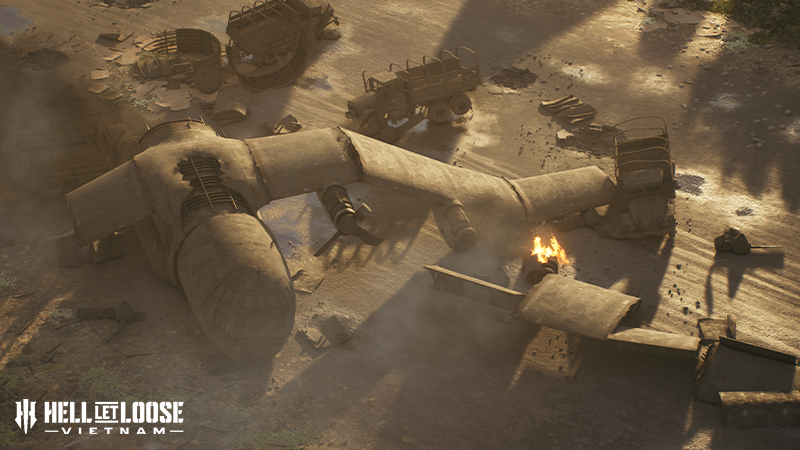
Hell Let Loose: Vietnam was rebuilt in Unreal Engine 5 using the original Hell Let Loose codebase as its foundation. This helped the team preserve the familiar feel of the franchise while upgrading its underlying technology and introducing new features. During development, this occasionally resulted in temporary World War II assets appearing in Vietnam. Some players may remember spotting a World War II aircraft during the Open Beta. This was a development placeholder rather than an intended part of the final experience and has since been replaced.
The shared foundation allows both teams to learn from one another while continuing to develop their respective games as distinct experiences.
What were some of the most memorable development bugs?
Not every moment during development has gone according to plan, and several unusual bugs have become memorable stories within the studio. One particularly dramatic issue caused a helicopter pilot to grow to an enormous size after falling from the aircraft. The character model became larger than Thanh Hóa Bridge, with every player in the session able to see the giant soldier dominating the skyline.
Before the final helicopter model was available, the team also needed a temporary vehicle to test its flight systems. This resulted in a fully functional flying World War II jeep being used as the earliest helicopter prototype.
Although neither example reflects the final game, these temporary assets and unexpected bugs are a natural part of development. They allow the team to test important systems before final animations, models and visual effects are complete.
Which new modes will be available?
Alongside the returning Warfare and Offensive modes, Hell Let Loose: Vietnam will introduce Conquest and Domination.
Conquest has previously been tested in Hell Let Loose, but Vietnam's tunnels, helicopters and asymmetrical factions significantly change how it plays. These systems create new opportunities for movement and reinforcement as teams compete across multiple areas of the battlefield.
Domination provides an even more free-form experience, featuring dynamic objectives and battles that can develop in every direction. Without a single clearly defined frontline, teams must communicate effectively, move quickly and respond to threats across the entire map. Domination is the game's most chaotic and demanding mode, and the team are particularly interested to see how the community approaches it after launch.
What unseen maps are the team excited to reveal?
While players experienced Thanh Hóa Bridge during the Open Beta and may recognise Vạn Tường from the tutorials, several full-scale launch maps have yet to be shown in detail. These maps introduce a range of distinctive environments, including bamboo forests, industrial interiors, fog-covered terrain and more open landscapes.
Quảng Ngãi includes areas with limited visibility and grounded fog, creating a very different atmosphere from the Open Beta environment. Other locations feature industrial spaces, docks and areas inspired by the outskirts of Huế.
The game's desert environment provides another significant contrast, with open terrain and different tactical considerations for infantry and vehicles.
Together, these maps demonstrate the variety the team wants to deliver at launch, moving beyond the dense jungle environment commonly associated with the Vietnam War.
How will cross-platform play work?
When rebuilding the game's online infrastructure, one of the team's priorities was providing the same core online experience across PC, PlayStation 5 and Xbox Series X and S.
Players will be able to form parties and play together regardless of their chosen platform. However, the team also understands that not everyone wants to participate in full cross-platform matches, particularly when considering the differences between mouse and keyboard and controller input. Both players and community server owners will therefore have control over their preferred experience.
Server owners will be able to configure which platforms can access their servers, including full crossplay, PC-only or console-only options. Players will also be able to filter their search based on whether they want to join cross-platform matches.
Community-run servers will remain an important part of Hell Let Loose: Vietnam, with server owners able to create the environment that best suits their players.
Topic: Looking to the Future
The launch of the game represents the beginning of the team's plans for Hell Let Loose: Vietnam. Alongside additional maps, weapons, vehicles and uniforms, the developers want to introduce systems that evolve the core experience and give players new reasons to revisit existing content.
While several ideas remain exploratory rather than confirmed additions, they provide an early look at the areas the team is interested in developing throughout the game's live service.
What can players expect from the ANZAC content?
Additional uniforms and helmets inspired by the Australian and New Zealand Army Corps are already planned for an update after launch. The Australian uniform features a distinctive silhouette, including the iconic Australian military slouch hat and equipment appropriate to the period.
The team are keen to this show this content directly, and more information and visual previews will be shared when they are ready to reveal it.
Could more factions be introduced?
The Vietnam War involved forces from several nations, creating many possibilities for future uniforms, equipment and factions. The team is considering opportunities to represent additional Australian and New Zealand forces, alongside the Army of the Republic of Vietnam, South Korean forces and others involved in the conflict.
The team want community feedback to help determine which forces should be prioritised, and whilst historical research provides a wide range of possibilities, the order in which they are developed will be influenced by what players are most interested in experiencing.
Will additional helicopters be introduced?
Attack helicopters are one of the vehicle types the team is most interested in adding after launch. However, introducing a powerful vehicle to one faction creates significant balancing considerations. The team need to ensure the NVA receives suitable equipment or tactical options to counter that advantage.
Unlike World War II, where opposing factions often had comparable categories of vehicles, Vietnam's asymmetrical design means balance cannot always be achieved by providing each faction with an equivalent vehicle. While attack helicopters are highly likely to be explored, their implementation will need to support the strengths and identity of both sides.
What other vehicles could be added?
Armoured personnel carriers are another major area of interest for the development team. Many vehicles used during the Vietnam War were amphibious, allowing them to travel across both land and water. Introducing these vehicles could create new tactical opportunities, particularly on future maps featuring larger waterways, islands or coastal environments.
The team is also interested in expanding the role of smaller vehicles such as jeeps. Rather than serving exclusively as transport, these vehicles could support additional equipment or functions, including mounted weapons and potentially spotlights designed for future night-time environments.
As with every new vehicle, the aim is not simply to increase the amount of content available, and each addition should introduce a meaningful gameplay opportunity and complement the maps on which it appears.
Will dynamic weather be introduced?
Weather forms an important part of the atmosphere and identity of each battlefield, and some environmental changes are already present. During a match on Thanh Hóa Bridge, for example, the position and lighting of the sun gradually change as the battle progresses.
However, the team prefers carefully orchestrated environmental experiences rather than applying a generic day-and-night or weather system to every map. Lighting, weather, audio and visibility are designed together to support the intended mood and gameplay of each location.
A rain system was functional during development, but it did not reach the quality expected for launch and was postponed. The team has a roadmap for bringing weather back in the future, with monsoon conditions forming an important part of that ambition. Rather than functioning as a purely visual effect, heavy rain could significantly reduce visibility and change how players approach a battle. Snipers may need to relocate, vehicle routes could become more important and squads may be forced to adjust their tactics as conditions change.
The same philosophy applies to future night-time environments. Instead of simply darkening an existing map, the team wants to develop supporting mechanics such as flares, floodlights and changing visibility conditions.
The goal is to create memorable environmental events that meaningfully affect gameplay rather than providing minor visual variations of existing maps.
Could maps change through seasons or water levels?
The team is also exploring ways to remix existing battlefields through more substantial environmental changes. Seasonal vegetation, tidal systems and changing water levels could alter how players and vehicles move through familiar areas. A dried-out riverbed might create a new route for tanks, while deeper water could increase the importance of boats and infantry movement.
The team's procedural vegetation technology also creates opportunities to significantly change the density and height of foliage. An area containing short elephant grass in one version of a map could feature much taller vegetation in another, transforming sightlines, concealment and available routes.
These ideas remain exploratory, but they demonstrate how future variants could offer more than a different time of day. The intention would be to change the strategy, atmosphere and flow of a map while building upon an environment players already know.
How will communities and clans be supported?
Hell Let Loose: Vietnam will introduce Battalions, an in-game system designed to provide greater support for clans and organised communities. Battalions will allow players to form persistent groups, track statistics, progress together, unlock content and join servers with other members. They are intended to provide a central hub around which communities can organise their players.
The system has already been in development for several months, but the team decided it required additional work before it could meet expectations. It is therefore planned for release after launch rather than being included on day one.
The first version will provide a strong foundation, but the developers want Battalions to continue evolving in response to community feedback. Because the feature is designed specifically for players and organised groups, their needs will play a major role in determining how it develops.
Will era-appropriate music be introduced?
The team is actively exploring the addition of licensed music from the Vietnam War era, and early internal tests allowed a helicopter co-pilot to switch on a radio, broadcasting music from the aircraft as it travelled across the battlefield. This created a powerful and distinctive atmosphere, particularly when players could hear an approaching helicopter through its music before seeing the aircraft itself.
Discussions with music rights holders are currently taking place. However, licensed tracks cannot be confirmed until the necessary agreements have been completed. Should licensed music be introduced, the game will also include appropriate options for content creators and streamers. Players would be able to disable protected music locally, helping them avoid copyright claims, demonetisation or restrictions on uploaded content.
The team remains hopeful that era-appropriate music can become part of the game, but further details will only be shared once licensing arrangements are finalised.
When will the live-service roadmap be revealed?
Planning for the Hell Let Loose: Vietnam live service is already well underway. Developing post-launch content requires work to begin far in advance, meaning the team is already discussing and producing updates that will arrive beyond release.
The current plan is to provide an early teaser around launch, followed by a more detailed roadmap reveal shortly afterwards. Final timing remains subject to the development and approval process, and confirmed dates will be shared through the official Hell Let Loose channels.
The roadmap will provide a clearer picture of the team's plans for future maps, weapons, vehicles, features and technical updates.
What is the long-term vision for Hell Let Loose: Vietnam?
Expanding the selection of maps, weapons, vehicles and factions will remain an important part of the game's live service, but the team's ambitions go beyond adding more content. The primary goal is to continue evolving the core gameplay.
New systems such as weather could affect both future and existing maps, giving players new reasons to return to familiar battlefields. Other features may change how communities organise, how vehicles are used or how matches unfold across different environments.
The developers want each major update to make the game feel more refined, polished and responsive. Performance, stability and quality-of-life improvements will continue alongside new content throughout the game's life.
The technology used to gather crash information and diagnose online issues has also been expanded, allowing the team to identify edge cases and respond more effectively when problems arise.
Community feedback will remain central to this process. Players may identify options, settings and quality-of-life improvements that were not prioritised for launch, and the team intends to introduce those changes where they can meaningfully improve the experience.
A live-service game cannot remain static. As the community develops new strategies and expectations, Hell Let Loose: Vietnam will continue evolving alongside it.
What are the developers most excited for players to experience?
For Studio Technical Director Kieran D'Archambaud, one of the most exciting developments is the game's cross-platform online infrastructure and the ability for players to join their friends regardless of platform, as well as the improvements made to helicopters and server performance since the Open Beta. A server-side issue previously caused regular desynchronisation under heavy load, making player and vehicle movement feel less responsive, particularly while flying. This issue has now been addressed, providing a much smoother experience.
For Senior Art Director Ryan Howard, the most rewarding part will be seeing the stories that emerge naturally from each battle. These could include a squad reinforcing an objective at the last moment, a Commander turning the course of a match or a player rescuing teammates from an unexpected attack.
For Game Director Paul Rustchynsky it’s also about the unscripted moments created when players combine the maps, weapons, vehicles and tactical systems in ways the developers could never completely predict.
These experiences are at the heart of Hell Let Loose. The team provides the battlefield and its tools, but it is the decisions made by players that create the stories remembered and shared long after a match has ended.
Looking Ahead
That wraps up Part 2 of our Hell Let Loose: Vietnam Developer Q&A.
A huge thank you once again to everyone who submitted questions across Reddit, Discord and through our War Correspondents. While it wasn't possible to answer every question across these two videos, the team will continue sharing more updates as we approach launch and throughout the game's live service.
From cross-platform play and new modes, to future vehicles, weather and Battalions, the upcoming launch represents only the beginning of the team's plans for Hell Let Loose: Vietnam.
Community feedback will continue to shape the priorities that follow, helping determine which battlefields, forces, features and improvements are introduced next.
As always, thank you for your continued support.
We'll see you in Vietnam.