Tinto Talks #119 - Politics & Diplomacy [Update 1.4 Preview]

![Tinto Talks #119 - Politics & Diplomacy [Update 1.4 Preview]](https://clan.fastly.steamstatic.com/images/45613245/3ef2e7a2a3250a1ef87651714bd68704ed14f261.png)
Politics
Political Influence
Mana is back on the menu boys!
Seriously, though as you have noticed we had a lot of places in the game we end up with insanely varied gold costs for various actions, or weird usages of legitimacy or stability. This was creating balancing issues that were not present in EU4.
Political Influence is a new country currency, ranging from 0 to 100, and it represents your ruler's accumulated political capital. This currency if kept high increases the base crown power by up to 20%.
You gain it primarily through the total abilities of the ruler, and from the active ability of members of your cabinet. There are also laws and privileges that impact how much you will get from it.
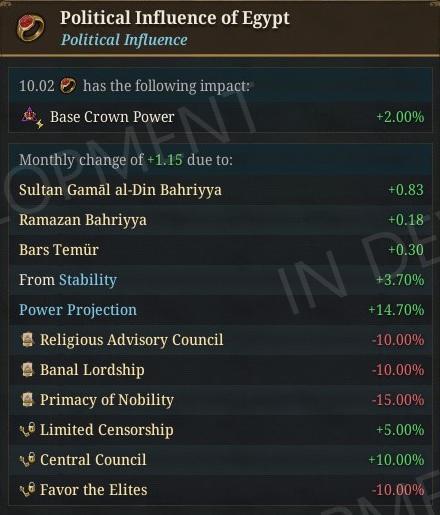
*You've seen bird mana, but now it's time for ring mana*
Political influence is spent primarily on estate related actions, including instituting new estate privileges which now cost political influence (Though revoking them still costs stability).
It’s also the primary currency used in the recently introduced estate interactions. Want that burgher money? It’s going to cost a temporary drop in crown power that storing political influence offers.
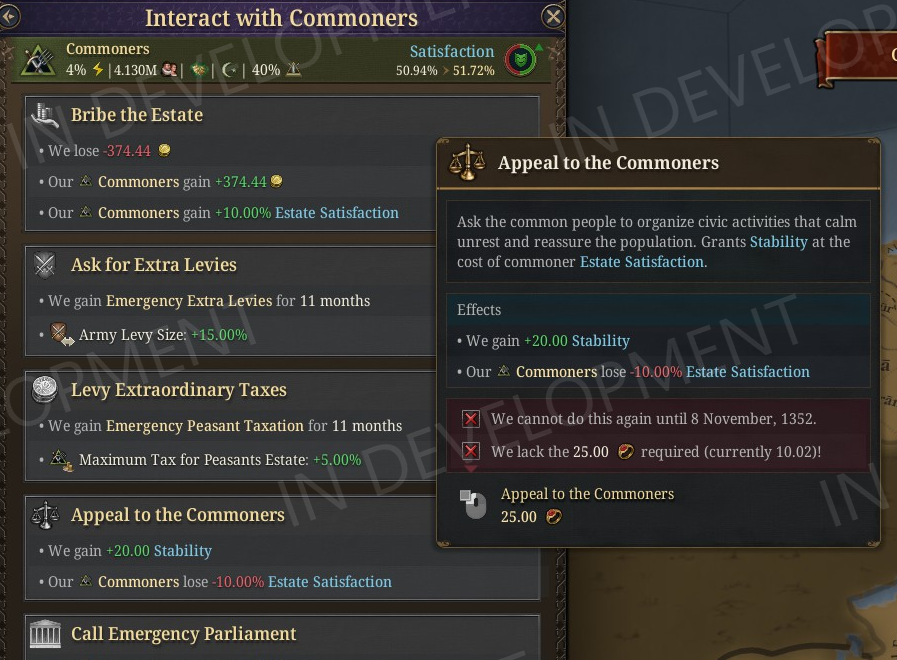
Spending influence on actions like these obviously has an opportunity cost too. It means you’re not spending it on other things.
Other things such as:
- Tolerating/accepting a culture
- Discriminating a culture
- Changing primary culture
- Urban rights
- Moving capital
- Appointing cabinet members
- Hiring courtiers
- Situation interactions
And:
-Applying political Pressure in parliament (spend 75 political power for 25 parliament support)
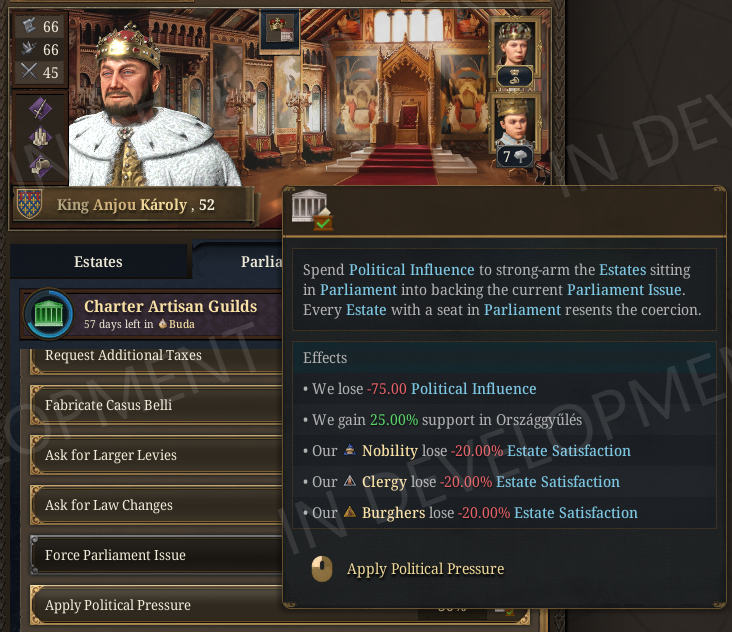
*The new applying political pressure parliament action using Political Influence*
Societal Values
Traditionalist vs. Innovative has changed. Instead of tweaking how efficiently you spend stability, the axis now affects stability investment and policy-change costs directly, leaning traditionalists toward cheaper policy shifts and innovators toward faster institution adoption.
Free Subjects now boosts pop goods demand instead of speeding up devastation recovery, giving the value a more visible economic footprint.
Mercantilism now raises your maximum tariff and trade-subvention ceilings, letting mercantilist states lean harder into protectionism, while Free Trade grants a straight trade income bonus.
Quantity now provides a substantial levy size boost in place of the old frontage modifier, making the "more troops" side of the axis actually deliver more troops.
Absolutism vs. Liberalism now grants increased monthly political influence on both ends, rewarding commitment to either extreme.
Societal-value parliament agendas now cost stability when enacted, rather than government power or prestige. Steering your nation's values is now a matter of political stability, unifying the cost across all these agendas.
Estate Private Armies
The Nobles and Cossacks have new privileges that allow them to maintain their own private armies, regiments that belong to the estate rather than the crown. The size of each private army scales with the estate's population, and its composition reflects the estate's martial traditions, favouring heavy cavalry for nobles and light cavalry for Cossacks. These regiments can be pressed into royal service, giving the monarch a temporary boost to their military strength at the cost of legitimacy.
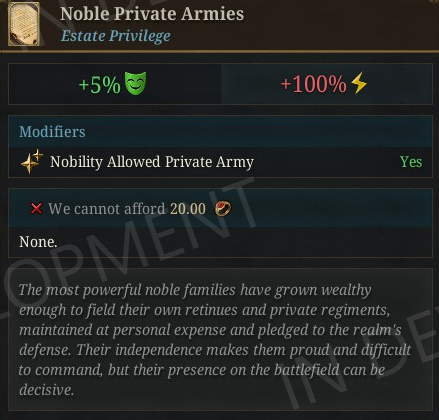
*New private army privilege*
Should the estate grow disloyal, it will recall its soldiers, stripping the crown of those forces at the worst possible moment. Countries with historical private army privileges begin the game with their estates already at full strength, so the political weight of those nobles is felt from the very first day.
These units are not levies, but actual regular regiments.
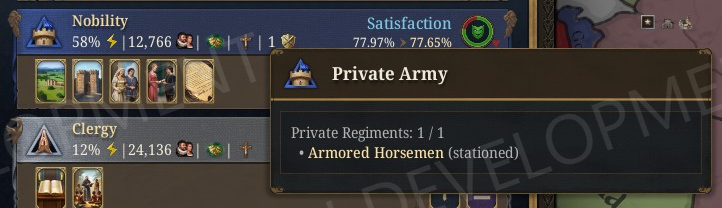
*Nobles heard horses are OP, they want some.*
Discriminated Cultures
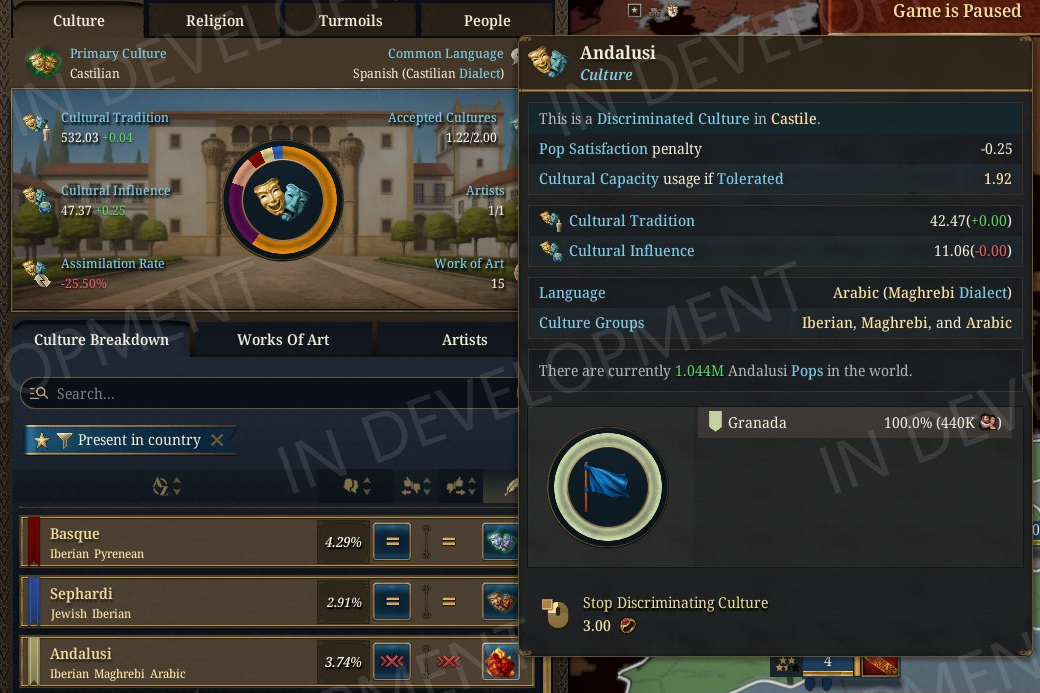
Sometimes you want to diversify how you treat different cultures even further. So we added a new level of view of cultures. First of all, the old “Discriminated” tier of culture acceptance is now renamed “Ignored”. Then we added a new level below that reuses the “Discriminated” name. This represents active oppression; it will dramatically increase cultural assimilation at the cost of pop satisfaction and increased emigration.
Estates will put forward Parliament Agendas to accept or discriminate against cultures that they like or dislike. Countries will dislike you for discriminating against their culture, or a culture they like.
Direct Domestic Migration
A new Age of Reformation advance unlocks the Direct Domestic Migration cabinet action.
This migrates the pops directly from one location to another specific one over 10 years.
Useful for evening out demographics after conquest, seeding underdeveloped arches, or feeding a single boomtown without waiting for organic migration. Runs in parallel with your other cabinet work, and you can stack several pairs at once if you can spare the slots.
The old cabinet actions still exists, this is merely to give more direct tools the more advanced your country becomes
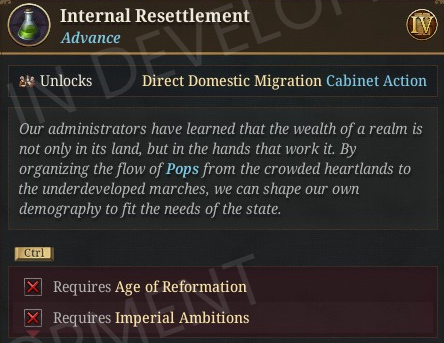
*Those who control their pops control their economies*
In addition to direct domestic migration action, we’ve also added more passive conquest related migrations. These promote more migration of pops to their previous owner’s capital if they are discriminated against by the new owner/conqueror. It’s not exactly “loyalty” but pops under a new regime that sees them as lesser might be more likely to emigrate to greener pastures.
Powerful Estates
One issue was that there were no major drawbacks to having overly powerful estates, so now there is a small drain on your legitimacy (or equivalent) if an estate has more than 25% power in a country. Making a more balanced estate playstyle have more incentive without being the only option.
Republic/monarchy/theocracies balance
One thing we realised was that monarchies had drawbacks to having low legitimacy and hordes had problems with low horde unity, while theocracies and republics could basically ignore it. We solved this in 2 ways, rebalancing effects and adding a couple new disasters.
We did a balancing pass over the penalties that kick in when a country's government power runs low. Theocracies in particular were getting off lightly, so low devotion now bites a little harder, weighing on the clergy estate and stability and feeding into apocalyptic dread for faiths that track it. The goal is simple: whether you rule as a monarchy, a republic, or a theocracy, letting your core government power collapse should hurt in comparable ways. The new disasters are WIP, but there will be one for Theocracies and one for Republics, and they should serve as an incentive to keep your legitimacy high
New Capital Buildings
We've evened out the unique capital buildings, which until now leaned heavily toward monarchies. Theocracies, steppe hordes, and tribes each get their own capital flavor building (the Sacred Council, the Khan's Ordu, and the Chieftain's Hall), republics gain a second one in the Patrician Hall, and theocracies also pick up the Temple Militia for capital recruitment, except for military orders, which already have their Order Headquarters.
We've also reworked the Royal Garden so it grants diplomatic capacity and a touch of cultural influence rather than minting diplomats directly, so it no longer doubles up with the Diplomatic Corps cabinet action.
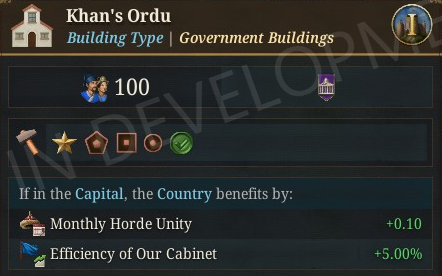
An Ordu fit for a Khan
Estate & Pop Power
We have changed how power is generated by your population. Previously the weight of each pop was tied to the estate it belonged to, which meant the same kind of person counted very differently depending on the estate; for example, a noble in the dhimmi or tribal estate contributed almost nothing politically.
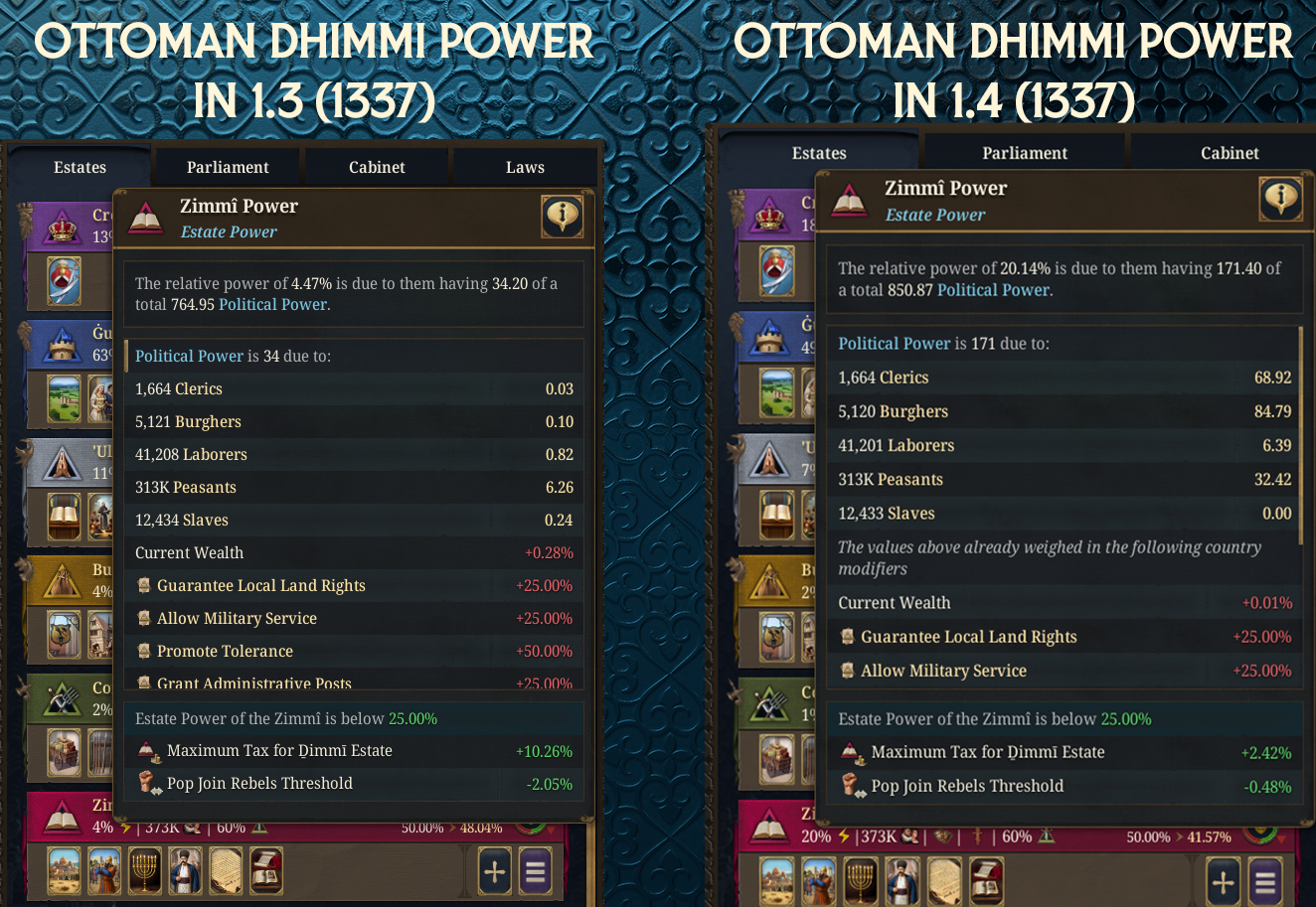
Now political weight is an intrinsic property of the pop type itself, so a noble pulls the same political weight no matter which estate they sit in, and an estate's overall influence reflects its actual composition of nobles, burghers, peasants and so on. While in a vacuum this is a pretty big change, in practice a vast majority of vanilla game states this actually impacts is in relation to the Dhimmi estate or in very niche scenarios with tribesmen.
Revolts
Civil wars and revolts have often felt like a minor speed bump once you reach the mid-game, primarily because the rebel forces lacked the initial momentum to pose a genuine challenge to a stable empire. We have overhauled how these uprisings begin to ensure they are a credible threat that requires your full attention.
First, we have addressed the organizational state of rebel armies. Previously, newly raised levies in a civil war often were way too small, as the locations had low control, and thus had basically no levies to talk about. Now, rebels will seize immediate and full control over their starting territories, allowing them to field their full regional levies from day one, just as a secessionist state would.
Financial backing has also seen a significant boost. Rather than starting with empty pockets, pretenders and estates revolting now begin with a treasury equal to their full annual tax base. This ensures they have the liquid capital to immediately hire mercenaries and maintain their armies during the critical opening months of the conflict.
Finally, when an estate rises in revolt, they no longer leave their wealth behind. They will now abscond with a quarter of their hoarded gold reserves to fund their rebellion. This means a wealthy and influential estate is now far more dangerous to cross, as their private war chest will directly fuel the fires of civil war.
---
Diplomacy
Demand War Leadership
War leadership is no longer automatically handed to the most powerful country when a war begins , the nation that was declared upon keeps command unless someone acts to change it.
A war leader can now “Offer War Leadership” to a stronger country not yet in the conflict, enticing them to join by granting them command from the moment they enter.
Powerful war participants who are not in command can instead “Demand War Leadership” from a weaker leader on their side, compensating them with favors and trust, though a refusal will sour relations. Both actions are available from the diplomacy screen, and a shortcut button appears directly on the war panel whenever you are in a war you do not lead.
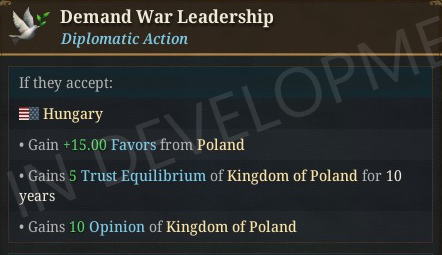
*New war leadership diplomatic action*
Inheritance Contracts
**Personal Unions have always been a cornerstone of diplomacy in Europa Universalis. In EU5 they often come about through patient but somewhat passive planning. In update 1.4 we’re adding a new aspect to unions that should bring a much needed layer of agency, and open the doors for some big brain succession schemes. *Inheritance Contracts*.
In essence, a paying monarchy can approach any heirless monarchy and offer them a lump sum of gold (scaled by development, roughly 50-1500) in exchange for the right to inherit their realm in the event their monarch dies before an heir is declared. While the contract holds, the buyer enjoys +1 Diplomatic Reputation and a permanent +1- opinion swap with their partner, the seller pays for the privilege with -1 Diplomatic Reputation and a small amount of prestige decay. If their childless ruler does indeed die on the throne the buyer immediately inherits everything as the senior partner of a new personal union.
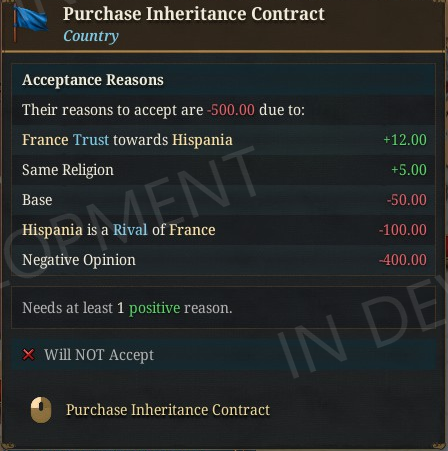
*TT119 Inheritance Contract*
Betrothals
**If personal unions are a cornerstone, Royal Marriages are the mortar that help keep them together. One small but meaningful addition that has been requested since day 1 from players both new and veteran is betrothals, so we’re adding them in with 1.4.
A betrothal is a promise of marriage between two courts, while one or both of the prospective spouses are still children (Age 2 and up). Betrothal opinion bonuses are smaller than marriage opinion bonuses, until the royal marriage is completed when both characters come of age of course.
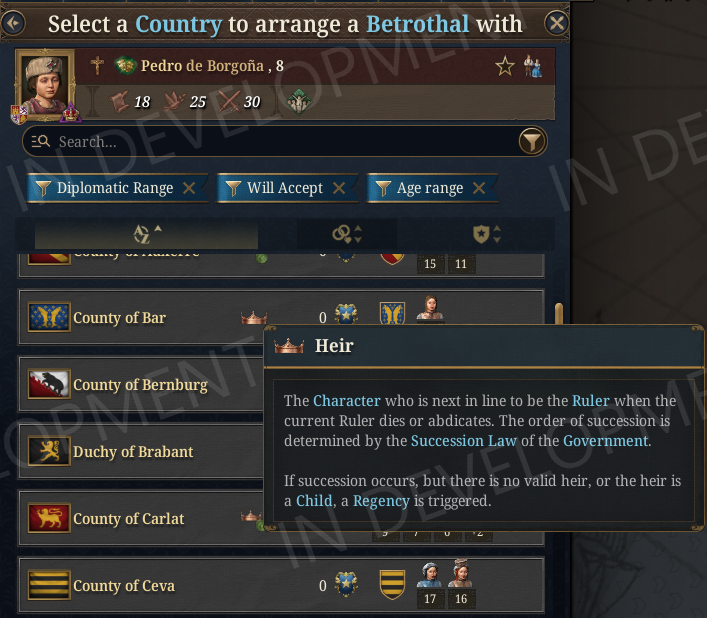
*Good bethorals can often secure a future personal union!*
Either side can break a betrothal, though it costs a hefty amount of prestige and opinion, which risks turning a prospective ally into a potential long term enemy. Like a player would, we aim for the AI to hold a little bit of a grudge when it comes to breaking these betrothals, so as to have the choice be *somewhat* of a commitment, with the option to break at a penalty. In the case one of the betrothed dies before the wedding, the betrothal will dissolve with no diplomatic penalty, though it still fires its own on-action, so flavor events (Both Vanilla or mods) can react accordingly. If you want to get free of betrothal without having to break it with penalty, maybe hunting accidents can be your friend?
Hegemonies
Being a hegemon no longer punishes you for your success: the antagonism penalty is now a flat +10% instead of stacking to as much as +100% for holding all five hegemonies. On top of that, each hegemony you hold now grants +1 diplomatic reputation, so dominance finally reads as the prestige it's meant to be rather than a reason to hold yourself back.
Some other changes to Diplomacy coming in 1.4:
- We removed the trust equilibrium target we added for 1.3 as it bloated savegames too much, while not adding much to gameplay.
- We lowered the base annexation cost from 200 to 50.
- Diplomat cap raised from 1 to 3 (regeneration rate unchanged, so pacing is the same, less "always capped" friction).
- Low-opinion targets no longer hide diplomatic actions — four actions that required positive opinion now stay available as long shots down to −50.
- Fixed diplomatic reputation being double-counted in acceptance chances — trust already factors reputation in, so the redundant term was removed everywhere the two overlapped.
- Turning on Diplomacy automation no longer hands the AI a blank check. Previously it could run almost any diplomatic action on your behalf, including things you would never want done automatically. High-stakes actions are now off-limits to automation entirely. The game will never change your rulers, convert your primary culture, change your religion, or alter succession laws behind your back. Automation now works from a curated, opt-in list. Only actions specifically flagged as safe for automation are carried out for you, so nothing surprising happens while the system runs. The objectives you actually control in the automation menu, such as improving opinion, forming alliances, and arranging royal marriages, keep working exactly as before. The automation tooltip now spells this out clearly, so you can see at a glance what the game will and will not do for you. Content designers get a simple new switch to mark an interaction as automation-safe, making it easy to expand the list responsibly over time.
- Some diplomatic actions are simply too important to hand to automation, or otherwise had unintended automation behavior, so they can no longer be automated at all. Declaring wars, joining or creating international organizations, and forming alliances are now always your decision. Those three toggles have been removed from the automation menu entirely, since they no longer do anything under automation. The menu now shows only the actions the game will actually manage for you.
- Sending gifts is now opt-in. It spends your gold, so it is switched off by default, and you can turn it on if you want automation to use gifts to win over other nations.
- Royal Marriages automation now works properly. It previously had a few bugs associated with it, and it now better does what it says, arranging marriages on your behalf when you leave it on.
- The remaining automation options, improving opinion, currying favors, managing subjects, and the two above, keep working and can each be toggled independently.
- Automation used to cancel diplomatic actions it did not recognize as its own. If you personally started building a spy network, currying favors, sending economic support, or improving relations, automation would often tear it down again on its next pass. This was the root of the "automation keeps fighting me" frustration.
- The game now remembers who started each of these ongoing actions. Anything you began by hand is marked as yours and is left completely alone by automation. Automation only cleans up the actions it started itself. When it decides one of its own opinion or influence efforts is no longer worthwhile, it cancels that, and only that. This applies to all four relationship-building actions automation touches: building spy networks, currying favors, economic support, and improving opinion. The distinction is saved with your game, so it survives reloading, and it works correctly in multiplayer.
- Other countries constantly ask to move armies or draw food through your land. Handling every one of these requests by hand is tedious, so you can now let automation answer them for you. A new "Answer Access Requests" option in the diplomacy automation menu lets the game accept or decline incoming military and food access requests on your behalf. Automation applies the same judgment the AI itself uses, so requests from trusted friends tend to be accepted and requests from rivals or the untrustworthy tend to be declined. This is fully opt-in and off by default. If you leave it off, nothing changes and you keep getting the usual prompt for every request. It only ever touches incoming military and food access requests. No other kind of proposal is auto-answered, so nothing high-stakes slips through.
- When you let automation improve relations for you, it used to choose the targets entirely on its own, often courting countries you did not care about. You can now hand automation a shortlist. A new "Improve Relations Targets" option in the diplomacy automation menu lets you pick exactly which countries automation is allowed to warm up to. While your list has countries in it, automation only spends effort on those. It will not wander off to improve relations with anyone you did not choose. Leave the list empty and nothing changes: automation goes back to picking targets on its own, just as before. The feature is entirely opt-in. Choosing targets uses the familiar country-selection panel. Click a country to add it, click again to remove it, so the whole list is managed from one place.
- The "how many countries would accept this" number used to read zero whenever you had no diplomats to spare, which is exactly when you most want to plan your next move. That count now reflects who would actually accept, whatever your diplomat situation. You still cannot carry the action out without a diplomat, but you can see where it would land before you commit one.
- Diplomatic actions used to vanish from the list entirely when something temporary was in the way, being at war, low opinion, or simply having no diplomats free, leaving you guessing what was even possible. Those actions now stay visible but greyed out, with the reason shown on hover. Only actions your country fundamentally cannot perform (wrong government, culture, and the like) are hidden. The result is a stable list you can read at a glance, instead of one that shifts as your situation changes.
- Some hard rejections were expressed internally as huge penalty numbers, so a tooltip could show a jarring line like "At war: -1000.00" and a nonsensical grand total. Hard blockers now read as a plain "will never accept" line, and the summary no longer lets a single blocker swamp the math, so the breakdown reads clearly.
Stay tuned, next week we've decided to show off a first look for the first implementation of a certain content feature (*not missions*) making a return from past EU games...
Until next time!