Tinto Talks 118 - Introducing 1.4 + Miscellaneous Changes

Hello everyone! Happy Wednesday, today we’re excited to start going into more details on update 1.4. Last week we discussed some of the scope changes we made to 1.4, so we highly recommend you read that short but important Tinto Talk if you haven’t already.
To recap, Ambitions have been moved to the future so we can spend some more time, love, and testing on them. And update 1.4 is *not* focused on colonization, but rather a pre 1500s Iberia.
Our Vision for Update 1.4
Every Europa Universalis has been a game about what you can become, but we want 1.4 to lean more into how many more ways there are to get there. For a long time, the paths to power felt somewhat accidental. You waited for the right marriage, the right heir, the right moment for a neighbor to overextend. The game rewarded patience, but it didn't always reward *player initiative*. In some ways it felt as if you were simply reacting to these situations rather than forging a path. (Not to mention the randomness involved in that)
This update aims to give the player more initiative back. Here a system used to have one correct shape, it now flexes to better fit the story you're actually trying to tell. The player should not have to wait for the world to cooperate. We’re aiming for things you can actually track and pursue more actively.
We want 1.4 to improve on player agency. Many of these systems take something that used to be an outcome and try to turn it into a choice, with the associated trade offs of course. Which hopefully means 1.4 giving you the player more opportunities to find and have fun with.
With that gameplan in mind, 1.4 also brings a lot of various cleanups, and we wanted to touch on some of the small but meaningful ones today. Including minor colonization changes, among other miscellaneous improvements including population growth, combat balance, and a new Egyptian Plague.
So let’s have a look we’re at with those!
Colonial Charter Goals
Colonial charters are now created with different goals in mind, these goals can be defined by the player upon charter creation. This means that you no longer have to make the decision via event popup when the charter is finished. There is a “best-fit” preset when a colonial charter is started, but you can change it to what you prefer at any point.
Form Colonial Nation - This will form a new colonial nation as a subject to your country.
Join Colonial Nation - This allows you to select another colonial nation that is in a neighboring area or has the capital in the same region for this charter to join. This can be useful to create bigger and more feasible colonial nations.
Keep as Territory -****This will then become an integrated or core location for your country.
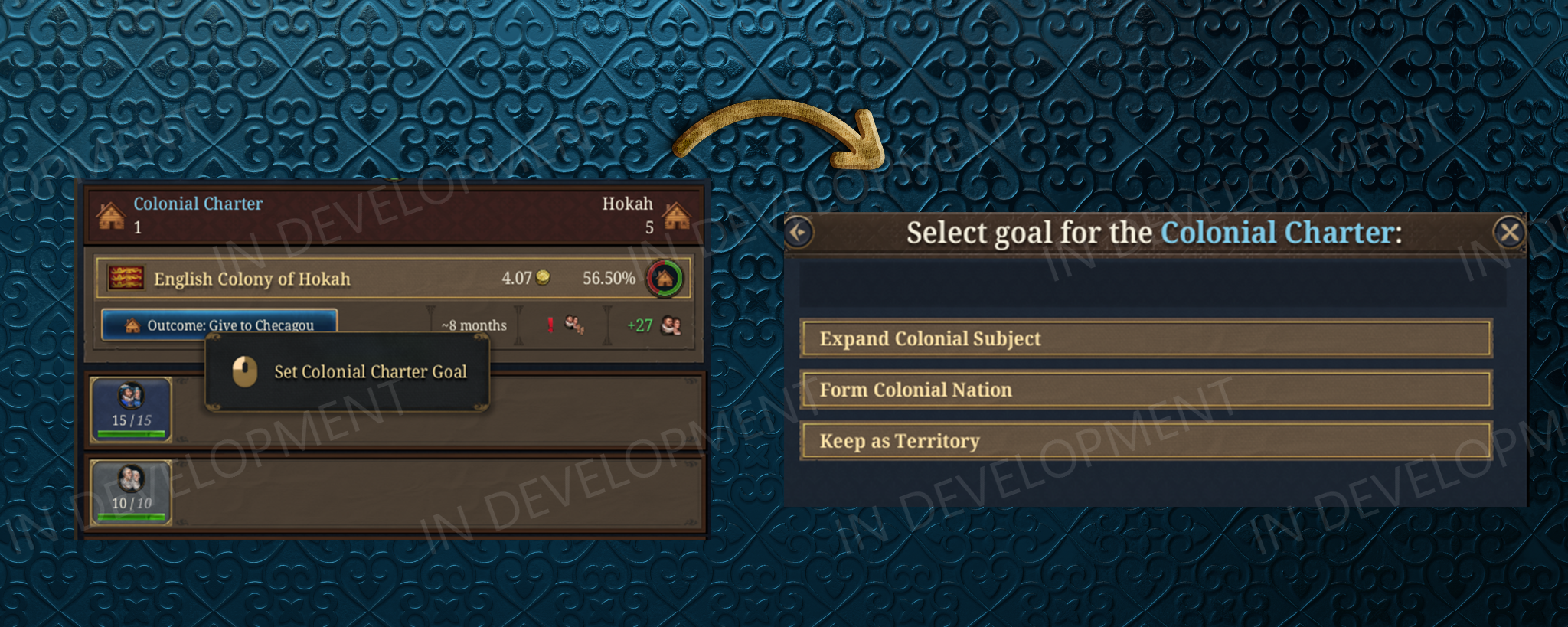
*Expanding your existing colonial subjects for better trade to the mainland, or aiming for some new overseas territory? *
Colonization Changes
In current versions, colonies tend to suffer from a lack of direct interaction. You found a charter, watched progress inch forward, and waited until it’s finished. 1.4 adds some extra context to colonial progress, with indications on migration and ETAs for the next settlement
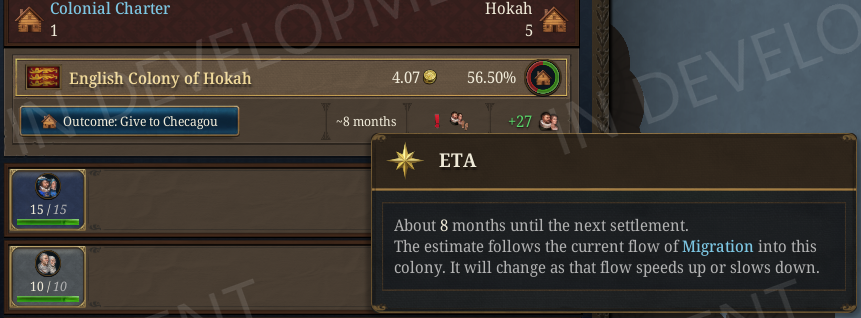
*Plenty of time to focus on other things… I’m sure nothing bad can come from ignoring colonies. *
We’ve also added milestone messages so that you can feel a more tangible sense of progress.
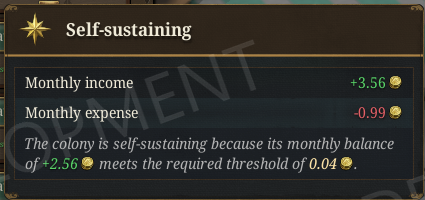
And now Fully established and self-sustaining colonies, will now be marked clearly as “Self Sustaining” which should be some nice quality of life to determine which subjects are self-sustaining and which are not.
Conquistador Changes
Conquistador construction now takes place in a homeland port instead of a colonial port, so the demands don't cripple the colony they come from. You can also join Conquistador wars (Doing so automatically makes you the war leader), if you so choose.
We’ve also added a few messages and minor UI improvements to help you better track what it is your conquistadors are actually doing.
Conquistadors also come with auxiliary units, to prevent them from starving to death so easily
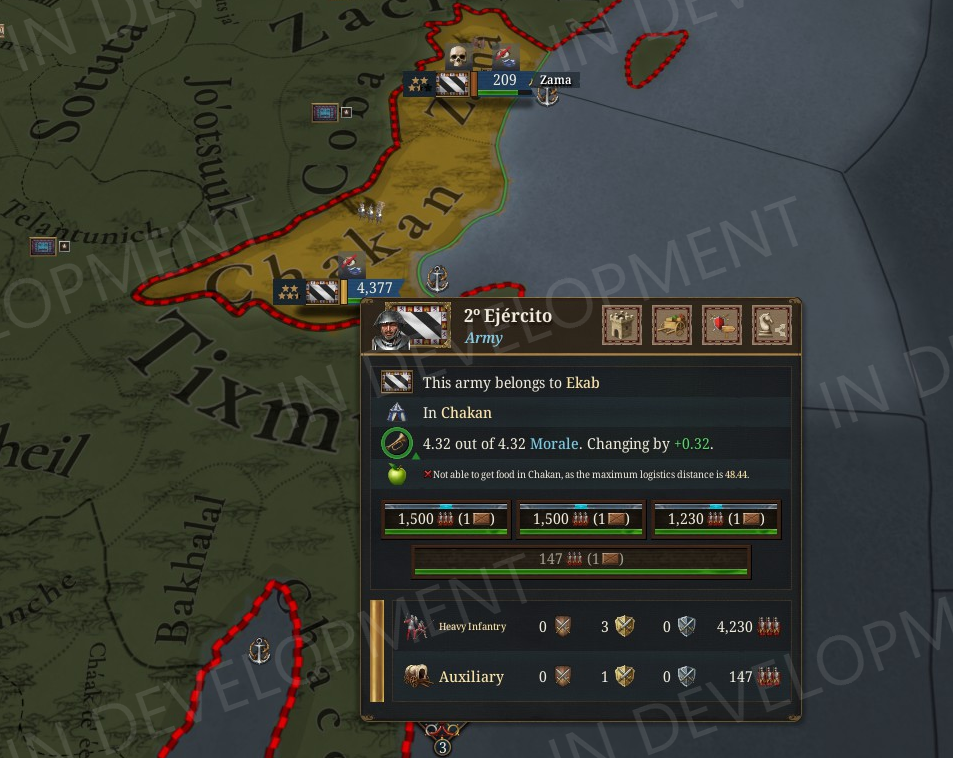
*When exploring the jungles of the new world, don't forget your food wagons.*
Slavery UI Improvements
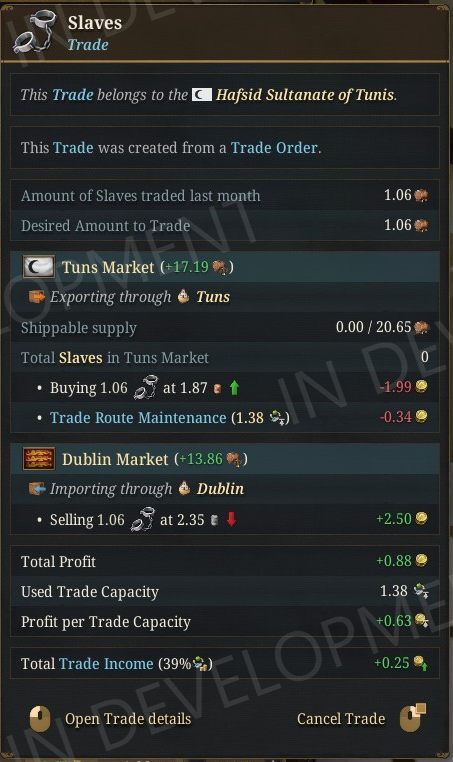
Slave trades now show how much supply can actually be shipped and how much slaves the source market has.
Population Growth Changes
Population is at the very core of EU5, and while its interconnectivity with practically every other system brings with it many landmines to avoid before we can get it perfect, it’s also got a lot of different levers for us to pull in terms of balance. Ok enough fancy marketing words, here are the changes to population coming with 1.4:
- Population growth now comes from actual food surplus rather than hoarded stockpiles
- Spare land no longer speeds population growth on its own; food surplus drives it
- Population growth now slows near capacity, and overcrowded locations lose people
- Large cities and harsh winters now sharply reduce local food production, scaled by settlement size
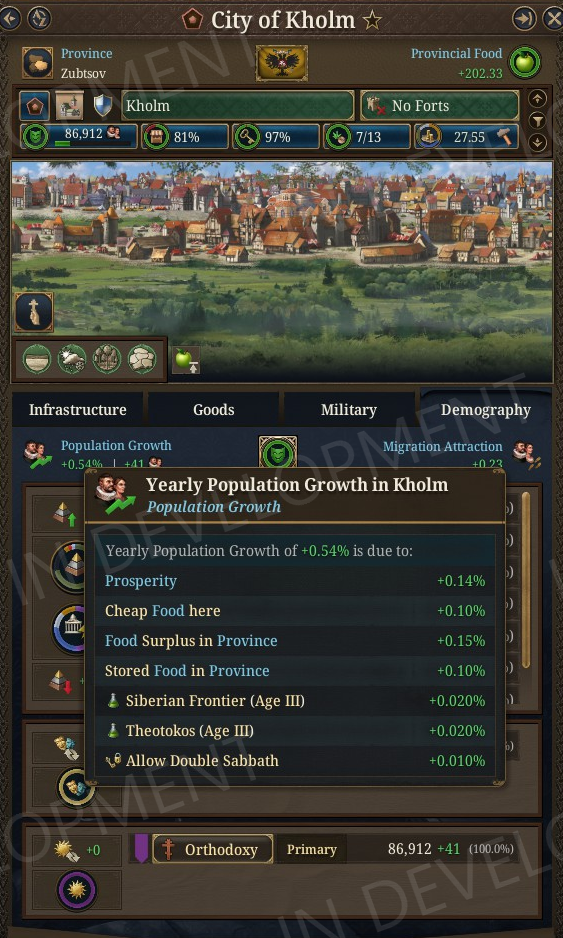
*Some of the Yearly growth in 1.4*
- Added the Village Granary, a rural food store buildable without a town
- Hospitals and medical buildings can no longer make a location totally immune to disease; built-up resistance is now capped
- Speaking of plagues…*
Egyptian Plague
It’s been a common thread of feedback for a while that Mamluks are a sleeping giant who never truly falls. Historically they suffered from a variety of disasters at the time. So to represent *some *of this turmoil, Egypt now hosts its own endemic disease, the Egyptian Plague.
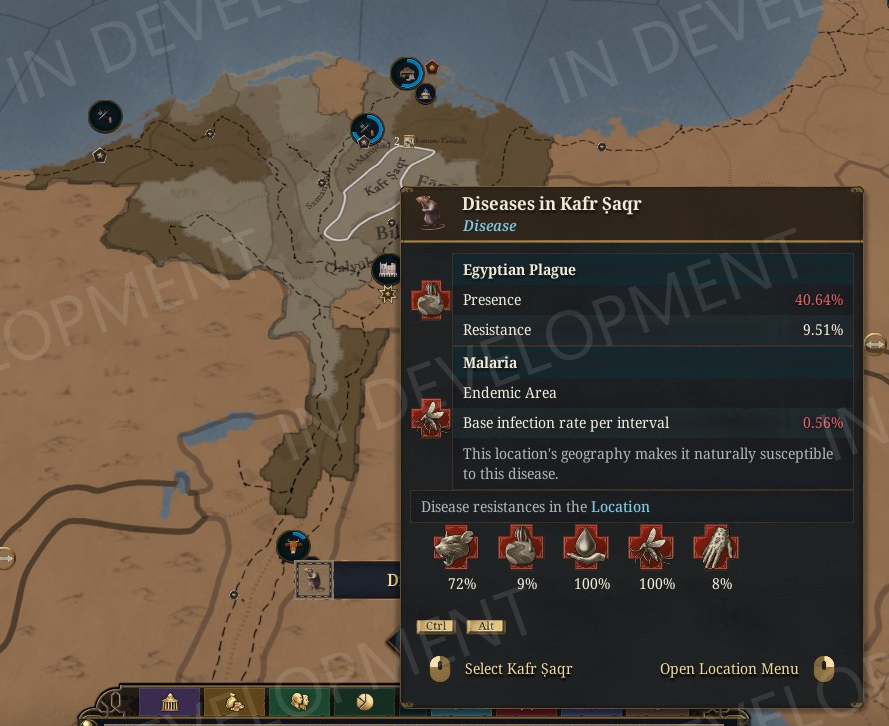
*Yes I’ll have one Egyptian Plague with a side of every other plague please. (Icon WIP as you can see)*
The Egyptian Plague models the 50+ recurrent outbreaks the Mamluk Sultanate suffered between 1348 and 1517. It spawns roughly once every few years in the Nile delta, occasionally spreads into the Levant, and, crucially, runs on its own resistance track, which means Black Death survivors get no immunity. We anticipate this should severely limit the capabilities of Mamluks, and hopefully serve as a fun challenge for players who want to suffer enjoy the offerings of the Egyptian plague.
While the aim is to keep AI mamluks from being a powerhouse everygame, this will likely require a few balance passes so that:
- playing Mamluks is still rewarding even with the added challenge.
- Mamluks is not *guaranteed *to crumble every game. There should be a believable amount of both instances.
Mercenary Changes in 1.4
In patches 1.2.5 and 1.3.10 Mercenaries were very prevalent, and we felt even after the nerfs to them in 1.3.11 they are still a little bit overpowered. We also wanted to give them some more uniqueness and agency attached to them, so we’ve made some of the following changes:
- Mercenaries now cost roughly twice as much to hire upfront and 35% more in monthly upkeep, so relying on them through long wars is a real financial commitment rather than a cheap substitute for a standing army.
- In 1.4 Mercenary armies now consume 50% more food in the field compared to regulars, making long campaigns on hired troops a heavier supply burden. Update 1.3 already made levies consume far less supplies, so this helps to diversify the unit’s logistical niches. With levies consuming the least and Mercs consuming the most.
- Recruiting from rival soil now costs more. Mercenary companies raised in a location owned by a country you're at war with come with a hostile-territory surcharge on top of the usual hiring fee (25% by default).
- Nations can now profit from their mercenaries. When a foreign power hires companies raised in their land, that country can now collect a cut of the hire fee
- Added a new Mercenary Market law, unlocked in the Age of Renaissance
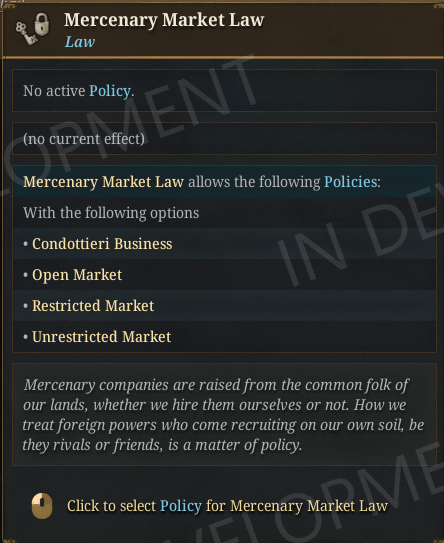
- Condottieri Business - Italian states have access to a unique condottieri-business policy: no surcharge for anyone (not even current enemies), but a bigger cut of every foreign contract, true to the historical Italian mercenary trade.
- Open markets - drop the hostile-territory surcharge and charge every foreign recruiter a standing fee.
- Restricted markets - raise the surcharge further to actively discourage rivals from poaching your manpower.
- Unrestricted Market - (1.3’s default behavior).
Manpower and Levy Changes
Firstly we reduced the mid/late-game manpower ceiling via a lower manpower_max_level slope, so manpower buildings can not stack as high in levels as before.
And secondly, levies, manpower, and sailors are now properly gated by control now. Low control on a location should effectively cut its military output in proportion to how little you hold there. A fully controlled location is unchanged, but a freshly conquered or rebelling location at 27% control now contributes 27% of its military weight even with a strong government modifier stack, with a floor of 10% so occupied land never produces literally nothing. The intent is that mid-control regions should feel meaningfully weaker than before.
Combat Changes
We reworked the Napoleonic Warfare Advance to now give +5% discipline, rather than allowing the researcher to ignore zone of control. While some people enjoyed the novelty of this advance, others felt it was simply unfun and didn’t fit well. Ignoring ZOC also had a tendency to slow down late games dramatically as pathfinding multiple armies was very heavy on processing times.
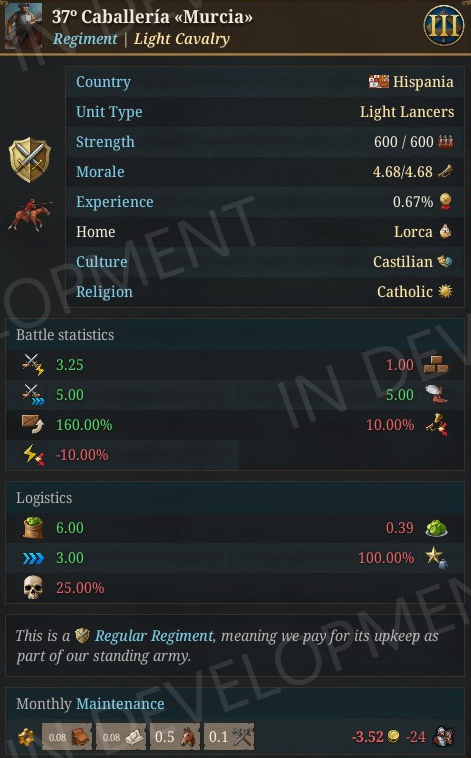
Cavalry was simply too strong as a standalone p: with a combat power of 4 against infantry's 1, and accounting for cavalry's smaller regiment size (40% of an infantry regiment's strength), a cavalry unit was delivering 60% more combat per battle line slot than infantry all the way through Age 3, which made pure-cavalry doomstacks a common build. We've lowered cavalry combat power from 4 to 3.25.
Though we want to keep cavalry the dominant arm right up until the Reformation, where infantry should cleanly overtake it. We've also reduced cavalry's flanking bonus (from +110% and +100% down to +60% for light and heavy cavalry), so massing nothing but cavalry no longer snowballs into constant stackwipes, and a proper combined-arms line of infantry in the center with cavalry on the flanks becomes the stronger choice.
Siege Changes
Artillery is now more effective in sieges: only 2 artillery regiments per point of bonus against forts instead of 3, so a siege train wears down fortifications noticeably faster
Forts in 1.4 auto-surrender when the garrison falls below 5% of their max, similar to how EU4. It used to be below 10 defenders, which may feel correct in a medieval siege of a castle, but not real in this era.
These changes are more of a small stepping stone in preparation for a more in depth siege rework in 1.5.
Improved Logistics
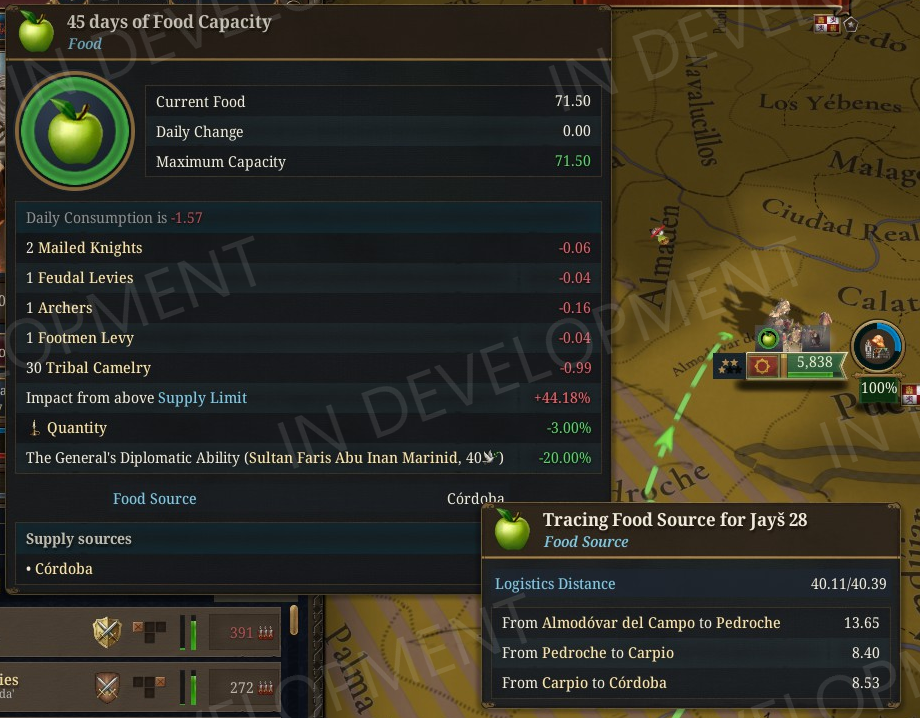
- Armies now Draw army food from multiple sources, highest-food first
- Armies draw from up to 4 ranked sources/tick (most food first, then nearest) instead of draining one source to zero
- Province supply preferred over a co-located depot (depot as reserve)
- A depositor can't re-draw from that depot for 30 days (self-drawback cooldown)
- Supply tooltip shows each source's live food + distance in a nested tooltip
_______________
And that’s a wrap for this happy Wednesday! Next week we’re taking a look at Politics & Diplomacy. Including Inheritance Contracts, And a new resource: Political Influence. Give us your thoughts and feedback below and we’ll see you then!